A little stroll around the rest house in the morning was very refreshing. Mr. Kadam took the two guard dogs of the house out for a walk. I hadn't seen them last night doing any guarding so I guess they are still trainees. The baby alsatian reminded me of Dog Detective Ranjha, a childhood hero and Mahabaleshwar resident (more on that below). The pomeranian being larger was leading and teaching and seemed to be doing a good job. They sniffed the bike but, probably realising it belonged to a guest, did not go further.

An uprooted tree trunk, caused by the monsoons.

After a winding climb, negotiating strings of shops, stalls and thelas, the vastness of tableland appeared like a field in the skies, the lunch table of the gods.
On my first visit with the collegetime biker gang, being on the lead bike we felt like kids in a candyshop but this metaphor changed for the observers following. Gunning the engine, smoking the competition, and speeding away we did not realise we were blowing clouds of sand in the faces of those behind till one of the bikes eventually overtook us. For them we must appear rather like the bull in the proverbial china shop, spoiling the event for the rest. As our convoy surveyed further inland, each bike was allowed ahead to take point and by the final muster everyone had equally sandblasted faces.
Nearer the road and shops were horses and horse carts awaiting passengers. At the centre of the table there was a cricket match in progress.


You can buy some shing-daana or peanuts to feed the monkeys that sit around to help you do precisely that.
Here, a baby bonnet macaque (thus named for its centre-parted, 80's style mullet hairdo) accepts a peanut in exchange for being photographed.

The Dhom dam on the Krishna river can be seen from the edge of the table.

A restaurant functions in a cave just below the edge, almost like a food cupboard under the table, in a larger picture.


Mahabaleshwar is 9 km away from Panchgani. This place called Mahabaleshwar first entered my imagination when it was mentioned as the hometown of a childhood hero of mine - Dog Detective Ranjha, a wonderdog with a supernose who sniffed out bad guys and solved many a dangerous problem in these parts. A 1978 book by Partap Sharma was his debut but my first exposure to this four-legged marvel was when the stories were serialised in a children's fortnightly comic book called Tinkle in the 1980's.

Access to a Tinkle comic was luck-based and getting hold of an issue didn't guarantee a full Ranjha story. I remember the feeling of impending doom in realizing that panel space was finishing but much remained to be told. The dreaded "to be continued" toe-tag would soon appear, nailing shut the coffin of reader hopes. Happily for fans like me, Amar Chitra Katha, the publishers, have now released the full collection.


The owner of this hotel-restaurant was a local with the surname Mahabaleshwarkar (literally: "from Mahabaleshwar") who turned out to have studied in the same college as my fellow rider. He gave us his business card to get in touch should we face any problems the rest of our journey. It was very kind of him and assuring him that such a need might never arise we returned to the temple parking. Standing in the sun had probably upset the bike's zen-like state because the engine wouldn't fire and, worse, the carburettor was dripping fuel. There were no mechanics within or near that area from what the locals informed us. A Bullet repair shop is also in the new town atleast 5 km away. We could have called our new friend but we thought testing a friendship within ten minutes of receiving it would be rude while also running the risk of making us look more like incompetent dorks than easy riders.
Ruminating on this while chewing some gum came the spark of another idea - the chewing gum to fix the leak. Tinkering a little this stop-gap was in place. A few mindful kicks in the shade and the bike bellowed back to life.

People from shops in the temple complex who had gathered around to help start the bike recommended visiting a panoramic spot called Arthur's Seat. On route we stopped someplace where a crowd was gathered and overheard a guide point a group of tourists to where three monkeys could be seen on the face of a mountain across the road. Try as I would squinting through the roadside wire fence I was unable to make out anything that fit that description. The tourists however instantly saw the monkeys and moved on.

Mentioning these elusive faces to the locals they said something to the effect that this monkey business was all in the mind and a call not to ape your fellow sapients in a tourist troop.

The Arthur's Seat viewing point turned out to be a 20 minute walk from the parking lot down an aisle-like stone staircase ending in a balcony. The view was breathtaking with hills to be seen stretching out into the far distance on all three sides. One can make out some blue and on clear summer days see the Krishna river near its point of origin.


Vast stretches of the Sahyadri hills can be seen.

The Venna lake is the traditional hilltop water activities point with boating being the favourite and promenade walks before sunset a close second.

Access to a Tinkle comic was luck-based and getting hold of an issue didn't guarantee a full Ranjha story. I remember the feeling of impending doom in realizing that panel space was finishing but much remained to be told. The dreaded "to be continued" toe-tag would soon appear, nailing shut the coffin of reader hopes. Happily for fans like me, Amar Chitra Katha, the publishers, have now released the full collection.

Like most hill settlements in India Mahabaleshwar has an eponymous temple at its high point in a section now designated Old Mahabaleshwar. We were famished and being told that the area was the best bet for good gharghuti (home-cooked) food places, a visit to the temple (no photography allowed inside even though a busload of schoolkids videographed on cellphones) was followed by a scrumptious brunch of shahi paneer, veg korma, cucumber raita, and butter nan in a place across the compound gate.

The owner of this hotel-restaurant was a local with the surname Mahabaleshwarkar (literally: "from Mahabaleshwar") who turned out to have studied in the same college as my fellow rider. He gave us his business card to get in touch should we face any problems the rest of our journey. It was very kind of him and assuring him that such a need might never arise we returned to the temple parking. Standing in the sun had probably upset the bike's zen-like state because the engine wouldn't fire and, worse, the carburettor was dripping fuel. There were no mechanics within or near that area from what the locals informed us. A Bullet repair shop is also in the new town atleast 5 km away. We could have called our new friend but we thought testing a friendship within ten minutes of receiving it would be rude while also running the risk of making us look more like incompetent dorks than easy riders.
Ruminating on this while chewing some gum came the spark of another idea - the chewing gum to fix the leak. Tinkering a little this stop-gap was in place. A few mindful kicks in the shade and the bike bellowed back to life.

People from shops in the temple complex who had gathered around to help start the bike recommended visiting a panoramic spot called Arthur's Seat. On route we stopped someplace where a crowd was gathered and overheard a guide point a group of tourists to where three monkeys could be seen on the face of a mountain across the road. Try as I would squinting through the roadside wire fence I was unable to make out anything that fit that description. The tourists however instantly saw the monkeys and moved on.

Mentioning these elusive faces to the locals they said something to the effect that this monkey business was all in the mind and a call not to ape your fellow sapients in a tourist troop.

The Arthur's Seat viewing point turned out to be a 20 minute walk from the parking lot down an aisle-like stone staircase ending in a balcony. The view was breathtaking with hills to be seen stretching out into the far distance on all three sides. One can make out some blue and on clear summer days see the Krishna river near its point of origin.

A photographer-for-hire
and a beggar/snatcher monkey sat to the right of the viewing platform,
both fixtures there according to the photographer. My friend asked him
if the monkey and he had now become friends sharing the same office
space and he said "no... because the monkey does better business."

Vast stretches of the Sahyadri hills can be seen.

The Venna lake is the traditional hilltop water activities point with boating being the favourite and promenade walks before sunset a close second.


By the time we left
Mahabaleshwar it was 6 in the evening. We had 55 km to reach
Satara city thence 125 km to Kolhapur and 60 km onward was the
final destination, Gadhinglaj. Vijay, the third friend who was to attend
the wedding tomorrow with the two of us, had already arrived from
Mumbai and occupied the pre-booked baratis' hotel room in the
southern part of town. He had brought some vodka along and was raring
for a long night of imbibing and reminiscing. Wishfully thinking that if we drove fast enough without stops
we'd make it by 10 pm, we told him to hang in
there.
It was already dark, the undulating roads were unlit, and yet the 55 km to Satara took less than an hour. I must here give credit to a 100 cc bike on the road in front of us that did a constant 80 km/h. The driver must have been a regular on these roads because he/she seemed to know every hump and turn. All I had to do was keep the red tail light within my sights at a 20 metre range.
Despite this early luck, we only reached Kolhapur city about 10:30 pm. Upon informing our friend waiting at the hotel 60 km away for the reunion party to begin he decided to call it a night and hit the sack being already exhausted from his Mumbai-Kolhapur bus journey. His troubles were over for the day but ours were only increasing. The disappointment of losing a third musketeer was less a concern now than the problem of navigating the 60 km off-highway side roads with their scarcity of lights, signboards, or people to help us.
It was already dark, the undulating roads were unlit, and yet the 55 km to Satara took less than an hour. I must here give credit to a 100 cc bike on the road in front of us that did a constant 80 km/h. The driver must have been a regular on these roads because he/she seemed to know every hump and turn. All I had to do was keep the red tail light within my sights at a 20 metre range.
Despite this early luck, we only reached Kolhapur city about 10:30 pm. Upon informing our friend waiting at the hotel 60 km away for the reunion party to begin he decided to call it a night and hit the sack being already exhausted from his Mumbai-Kolhapur bus journey. His troubles were over for the day but ours were only increasing. The disappointment of losing a third musketeer was less a concern now than the problem of navigating the 60 km off-highway side roads with their scarcity of lights, signboards, or people to help us.
Kolhapur is famous for its hardy leather slippers, the Kolhapuri chappals. This stall is right by the NH4 highway for travellers' convenience.

A liquor shop is a few doors down from the chappal store at this highway rest stop and conspicuous consumption can be observed in the front parking area. The photo below was clicked by one of these dedicated consumers. We realised this only after seeing this shaky-effect photo and hearing him say that it was the three other people in the frame that caused it to move.

Kolhapur is the
southernmost district of Maharashtra on the border with Karnataka. Even
though they are in the same district, the road from Kolhapur city to
Gadhinglaj town goes south into Karnataka for some time and then turns west into Maharashtra again. This wouldn't matter if we didn't have to
rely on signboards because the script on the signboards was Kannada and
the Kannada script is as much like the Devnagari script (for Marathi,
Hindi, Sanskrit etc.) as the Chinese script is to the Roman.
So here's a TRAVEL TIP (learned the hard way):
Learning a few words and phrases in the language of the country/region you are visiting is always a good idea. An equally good idea is to learn and/or make a note of the script (if different) in which the language is written. It helps with proper nouns like names of places, food items, transport etc. when reading signboards, warnings, restaurant menus, prices and so on.
So here's a TRAVEL TIP (learned the hard way):
Learning a few words and phrases in the language of the country/region you are visiting is always a good idea. An equally good idea is to learn and/or make a note of the script (if different) in which the language is written. It helps with proper nouns like names of places, food items, transport etc. when reading signboards, warnings, restaurant menus, prices and so on.

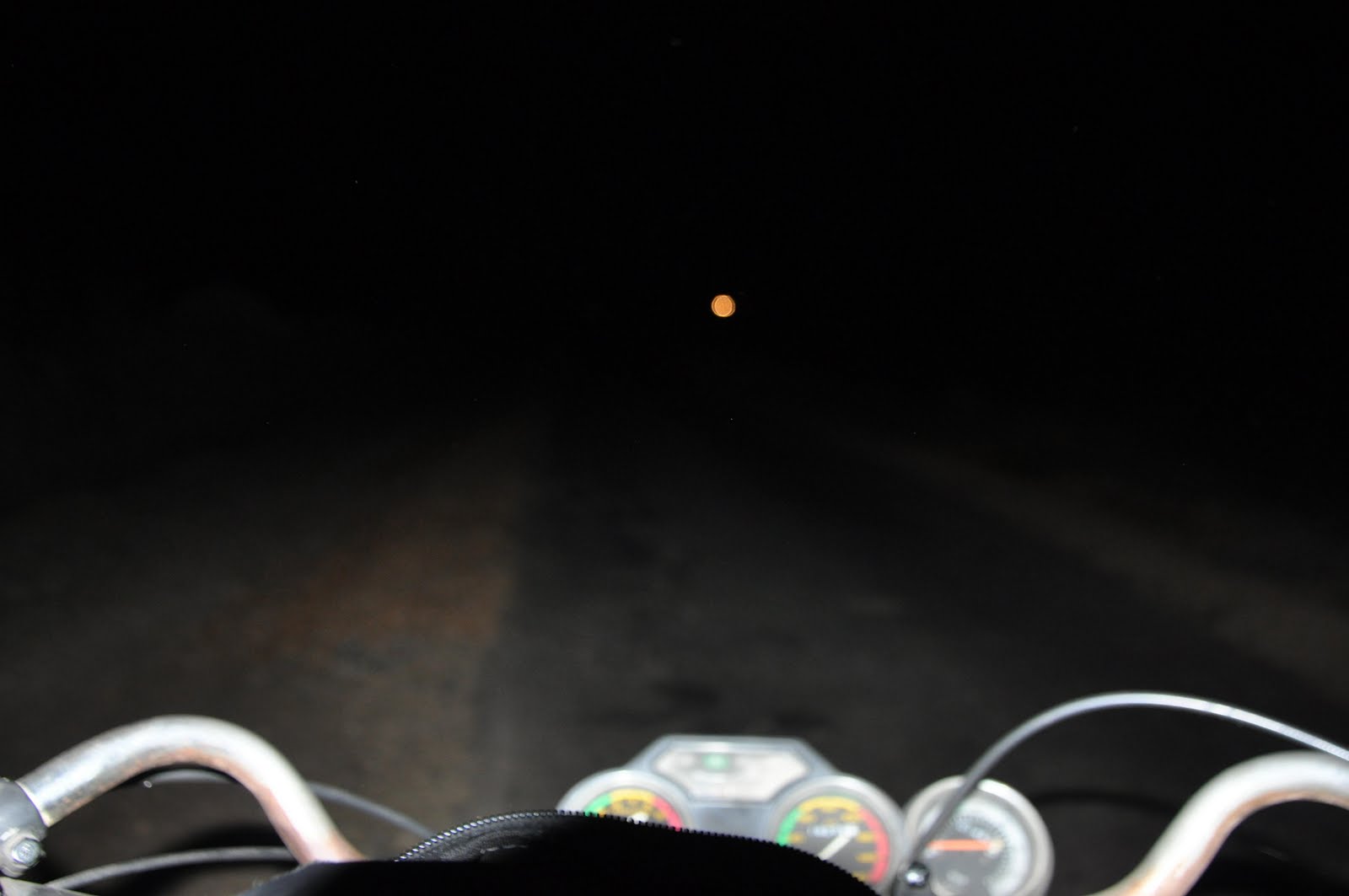
In the pitch darkness, the headlight cut only through a few metres so the going was slow. It was getting colder and a fog could be expected to start creeping in from the farmland. On both sides were what seemed like either farms with tall crops or swaying trees. At one point, out dashed a jungle cat chasing what appeared to be a brown hare across the road. We came to a three-way crossroads with no signboards. Not considering this a Monty Hall problem, faithfully following the original direction seemed best so we couldn't at least be failed for inconsistency. A dim light appeared in the distance every ten minutes or so and then seemed to disappear, UFO-like, into the murky darkness. Can't say if it was the same light in each instance but it certainly seemed so. If this road turned out to be the wrong one and we were forced to return down this path that light just might be our one hope for support until daylight, maybe even a place to sleep. I recalled a joke, and it carried the mood till our next light:
A travelling salesman was driving in the country when his car broke down. He saw a shimmering light in the distance and hiked up to find a farm house. An old farmer answered the door and the salesman asked if there was a place he could stay for the night. "Sure," said the farmer, "my wife died several years ago and my two daughters are 22 and 24 but they're away at college and I'm all by myself so I have lots of room to put you up." Hearing this the salesman turned around and started walking back to the road. The farmer called after him, "Didn't you hear what I said? I have lots of room."
"I heard you," said the salesman,"but I think I'm in the wrong joke."
About half an hour later a
signboard appeared. The script was back to Devnagari and the board said we
were on the right track. We reached a spot where two people were sitting
on a choir cot by the side of the road who gave us directions almost
to the gate of the hotel. We reached a little after midnight. There was
half a bottle of vodka still remaining along with packed dinner. It went
down well and was chased with a sumptuous repast of chapattis,
chicken curry, onion-tomato salad and rice.

However hard the cold day seems
If you have yourself a place to be
And hang your hat with warmth and sleep
It makes this blend a great recipe
For living rich and being happy
- Carlton Doyle


.JPG)